For adults
A way out of the diet cycle —
for good.
You deserve a happy and healthy relationship with your body and the food you eat. Together, we’ll build that — one conversation at a time.
The short answer: I offer 4- and 7-session intuitive eating packages for adults — virtual, nationwide, no meal plans, no weigh-ins. Sessions are one hour each, conducted over a secure video platform.

4-session package
Introduction to Intuitive Eating
A grounded starting point. We’ll cover the core framework and begin making peace with food.
- Four one-hour sessions
- Virtual sessions — meet from anywhere
- Principle-by-principle guidance
- Between-session reflections
7-session package
Deeper exploration
More time to go past the basics — especially helpful in the early, disorienting stages of unlearning diet culture.
- Seven one-hour sessions
- Virtual sessions — meet from anywhere
- Personalized focus areas
- Gentle nutrition integration
Looking for something different? Other packages are available on request — just reach out.
What to expect
No meal plans. No weigh-ins.
Sessions are conversational and compassionate. We’ll explore your history with food, untangle the beliefs underneath it, and practice new ways of listening to your body. Progress isn’t measured on a scale here.
- 1
A free introductory call
We spend 15–20 minutes getting to know each other and clarifying what you’re hoping for.
- 2
Your first session
We cover history, habits, and hopes. No plan yet — just listening.
- 3
Ongoing work
We move principle by principle at your pace, layering in reflection and self-compassion.
FAQ
Questions people ask
- What is intuitive eating, and how is it different from a diet?
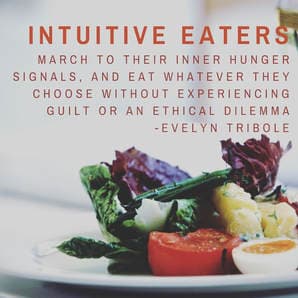
- Intuitive eating is a framework for rebuilding trust with your hunger, fullness, and satisfaction cues — not a plan for what to eat. Unlike a diet, it has no food rules, no weigh-ins, and no calorie targets. The 10 principles were developed in 1995 by Registered Dietitians Evelyn Tribole and Elyse Resch and are supported by over 200 peer-reviewed studies linking the approach to better body image, lower disordered eating, and more stable relationships with food.
- Will I gain weight doing intuitive eating?
- Bodies respond differently. Weight is not a goal or an outcome I track. Some clients see their weight stay stable, some rise, some fall — but the shared experience is relief from obsessive thinking about food and reduced binge episodes. If weight loss is your primary goal, intuitive eating is likely not the right fit, and I'll tell you that directly.
- How many sessions will I need?
- Most adult clients start with either a 4-session or 7-session package. Four sessions is a solid introduction to the framework; seven gives us the time to work through the harder middle stretch when old diet-mentality beliefs resurface. Many clients continue with occasional check-ins after the initial package.
- What happens in a first session?
- We cover your history with food, the patterns you're noticing now, and what you're hoping for. There's no meal plan, no food log, no weigh-in. The first session is mostly listening and setting a direction together. You leave with one small, concrete thing to experiment with before we meet again.
- Is this covered by insurance?
- I operate as an out-of-network provider. I can give you a superbill that you can submit to your insurance for potential reimbursement under nutrition counseling benefits. Coverage varies — check with your insurer about codes 97802 and 97803.
- Do you work with eating disorders?
- I work with disordered eating and chronic dieting. A diagnosed eating disorder (anorexia, bulimia, binge eating disorder, ARFID) deserves a full treatment team — typically a therapist, physician, and dietitian working together. If that's you or a loved one, please call the National Eating Disorders Association helpline at 800-931-2237 for a referral.
- Are sessions in-person or virtual?
- All sessions are currently virtual. You can meet with me from anywhere in the United States over a secure video platform — sessions are one hour and booked in advance.
Keep reading
The principles, in plain language.

A note on eating disorders: full-scale eating disorder recovery deserves a dedicated treatment team. If you or someone you love is struggling, please call the National Eating Disorders Association helpline at 800-931-2237.